The Ultimate Guide to a Mongolian Taiga Horse Trek
Most people picture Mongolia as an endless ocean of grass, a sun-drenched steppe where horses run free under an unobstructed sky. But if you travel far enough north, past the deep blue waters of Lake Khövsgöl, the grasslands begin to buckle and fold. The open steppe gives way to a dark, primeval wilderness: the Mongolian Taiga.
This is the southern edge of the great Siberian sub-arctic forest. It is a land of dense larch woodlands, treacherous peat bogs, jagged mountain passes, and rivers that run cold and clear. It is also the ancestral home of the Dukha (Tsaatan), one of the world’s last remaining groups of nomadic reindeer herders.
Reaching the Taiga is not a matter of driving; the roads end long before the forest begins. To enter this world, you must mount a sturdy Mongol horse and ride into the wild. This is a complete guide to horse trekking Mongolia‘s wildest northern frontier—widely considered one of the most physically demanding and spiritually transformative adventure treks on Earth.
1. The Landscape: Entering the Siberian Borderlands
The Taiga is divided into two distinct regions: the East Taiga and the West Taiga, separated by the vast Tsagaan Nuur valley. Both offer stunning, wild terrain, but they possess slightly different characters.
- The East Taiga: Known for its dramatic mountain valleys and slightly more open terrain. It is generally easier to navigate, though “easy” in the Taiga is a highly relative term.
- The West Taiga: Steeper, more heavily forested, and incredibly remote. The mountain passes here are higher, and the weather is even more unpredictable.
Regardless of which side you trek, the landscape is defined by the Larix sibirica (Siberian larch). These trees dominate the horizon, carpeted beneath by thick layers of spongy moss and lichen—the primary food source for the thousands of semi-wild reindeer that roam the forest.
2. The Engine of the Journey: The Mongol Horse
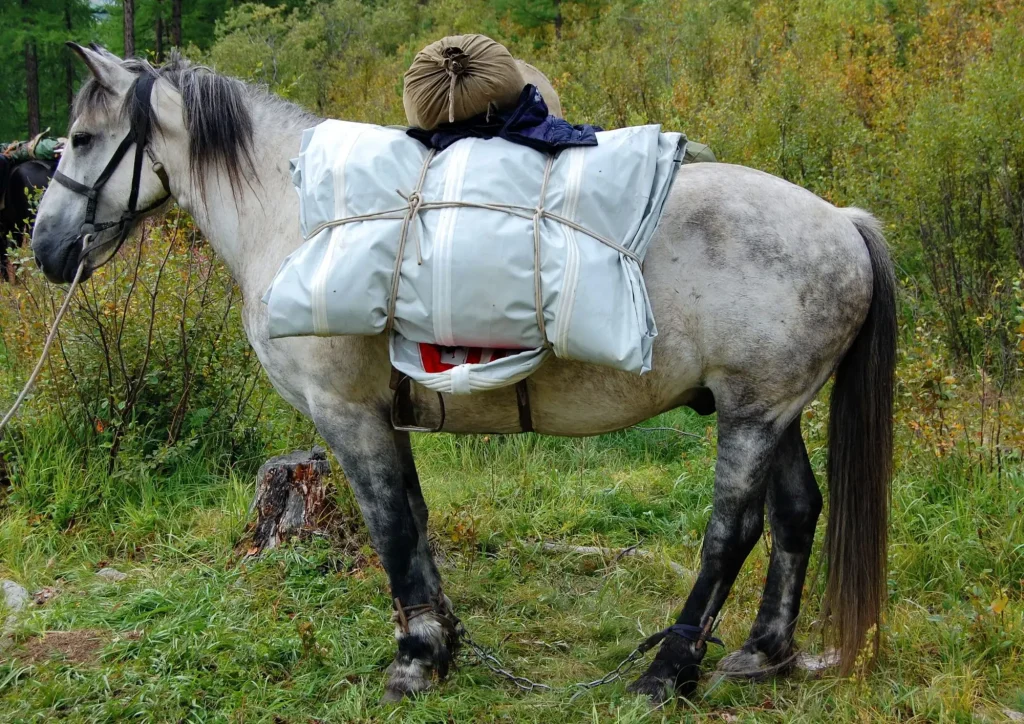
When it comes to horse riding in Mongolia, forget everything you know about polished Western equestrian style. You do not ride sleek, pampered thoroughbreds into the Taiga. Your companion on this journey is the Mongol horse. Small, stocky, and semi-wild, these beasts are the descendants of the mounts that carried the armies of Genghis Khan across Eurasia.
Built for the Bog
The Taiga is essentially a giant, high-altitude sponge. Much of the trail consists of “black muck” and peat bogs that would swallow a larger, heavier Western horse. Mongol horses possess an uncanny, almost instinctual ability to read the ground. They can sense the difference between solid earth and a bottomless mud pit.
When riding through the Taiga, the golden rule is simple: trust your horse. There will be moments when your mount chooses a path that seems illogical to you, or steps directly into a swampy patch. Let them have their head. They have navigated these bogs for generations, and their survival instincts are sharper than your steering.
3. The Experience: What the Trail Actually Feels Like
A Taiga horse trek is not a leisurely trail ride; it is an expedition. For those embarking on a horse riding Dukha expedition, the physical and mental rewards of the trail are unmatched. Here is what to expect when you are in the saddle:
The Physicality of the Trail
You will spend between 5 and 8 hours a day in the saddle. Your knees will ache, your lower back will protest, and muscles you didn’t know existed will burn. The terrain changes constantly:
- The Squelch: Hours spent navigating deep, black mud where the horses sink up to their knees. You will hear the constant schloop-schloop of hooves fighting the suction of the bog.
- The Climb: Scrambling up vertical, rocky mountain passes where you must lean forward, gripping the horse’s mane, as they power up the shale.
- The Squeeze: Navigating tight larch forests where you must actively guide your horse to prevent your knees from being slammed into ancient tree trunks.
The Arrival at the Ort
After a grueling day on the trail, cresting a ridge to see the white, conical orts (tepee-like structures made of larch poles and canvas) of the Dukha herders is a feeling of pure triumph.
Life in a Tsaatan camp is intimate. You will sit around a central stove inside an ort, drinking hot reindeer milk tea while the steam rises from your damp wool socks. Outside, the soft, rhythmic clicking of reindeer hooves (a sound caused by a tendon slipping over a bone in their foot as they walk) serves as the soundtrack to the sub-arctic night.
4. Need-to-Know: Seasons, Prep, and Survival
This is an extreme environment. Going in unprepared can turn a dream adventure into a dangerous situation.
When to Go
The window for a Taiga trek is incredibly narrow.
| Season | Months | What to Expect |
|---|---|---|
| The Peak | July – August | Warmer days ($18^\circ$ to $25^\circ\text{C}$), but high insect activity (mosquitoes and horseflies can be relentless). Mud is at its deepest. |
| The Autumn Gold | September | The larches turn a brilliant, fiery gold. No bugs. The air is crisp, but nights drop well below freezing ($-5^\circ$ to $-10^\circ\text{C}$). Early snow is common. |
| The Freeze | October – May | Brutal winter conditions. Unpassable for standard treks. Only accessible for specialized winter expeditions. |
The Essential Gear List
- Riding Boots & Chaps: Do not wear hiking boots. The stirrups of Mongolian saddles are designed for riding boots, and the lack of half-chaps will result in painful chafing on your calves within the first two hours.
- High-Quality Waterproofs: It can rain, snow, and shine all in the span of thirty minutes. Pack heavy-duty, breathable rain gear (both jacket and trousers).
- A “Muck” Strategy: Bring a pair of tall rubber boots (often purchased in the local market in Mörön or Tsagaannuur). When you have to dismount to lead your horse through a swamp, leather hiking boots will fail instantly.
- Insect Protection: In July and August, the Taiga bugs are legendary. Bring a head net and high-strength insect repellent.
5. Cultural Etiquette: Respecting the Dukha
Visiting Dukha families is a profound privilege. The Dukha are a deeply spiritual people whose lives are intertwined with the forest, their reindeer, and the spirits of their ancestors (shamanism).
- Respect the Reindeer: The reindeer are not livestock; they are members of the family. Never ride a reindeer unless explicitly invited by the owner (usually reserved only for children or very light individuals), and never chase or startle them.
- Fire Etiquette: Like the Mongols of the steppe, the Dukha hold the fire of the hearth sacred. Never throw trash, onion skins, or waste into the central stove.
- The Altar Area: The back of the ort (opposite the door) is the sacred space where family heirlooms or shamanic tools are kept. Never point your feet toward this area when sitting.
6. How to Do It: Ride With Us
The Taiga is a protected border zone adjacent to Siberia. Attempting to navigate this region independently is not only highly dangerous—due to the complete lack of trails and maps—but also illegal without specific border permits.
We specialize in arranging ethical, safe, and deeply immersive Taiga expeditions.
Why Choose Our Treks?
- Ethical Partnerships: We work directly with Tsaatan herder families. We ensure that they are compensated fairly for guiding, providing horses, and hosting. This direct economic benefit helps them maintain their traditional way of life against modern pressures.
- Animal Welfare: We veterinary-screen all the horses used on our treks. We rotate mounts to ensure no horse is overworked, and we provide comfortable, modern-modified saddles that protect both the horse’s back and your seat.
- Experienced Local Guides: Our guides are locals who have spent their lives in the northern forests. They speak the dialects, know every marsh and bog, and carry satellite communication gear for absolute safety.
- Bespoke Logistics: We handle the complex permit process required to enter the Russian border zone, arrange the 4×4 transport from Mörön to the trailheads at Tsagaannuur, and provide high-end expedition camping gear.
How to Book Your Expedition
Because of the delicate nature of the ecosystem and the communities we visit, we limit our Taiga horse treks to a few small-group departures each year.
- Step 1: Contact us to discuss your riding experience. This trek requires a moderate to high level of physical fitness and some comfort on a horse.
- Step 2: Choose between our Summer Wildflower Trek (July-August) or our Autumn Larch Trek (September).
- Step 3: Let us handle the permits, the horses, and the path. All you need to do is show up ready to ride.
Conclusion: The Scent of the North
When your trek ends and you finally dismount, your body will be sore, your clothes will smell of horse sweat and larch smoke, and your boots will be stained with black Taiga mud.
But as you look back toward the northern mountains, you will realize that you have left a piece of yourself in the forest. You have ridden through a landscape that cannot be tamed, spent nights with a people whose wisdom is as old as the trees, and proven your grit on the legendary trails of the North.
The northern forest is waiting. Let us lead the way.