What Is The Golden Eagle Festival: The 2026/2027 Golden Eagle Festival Guide
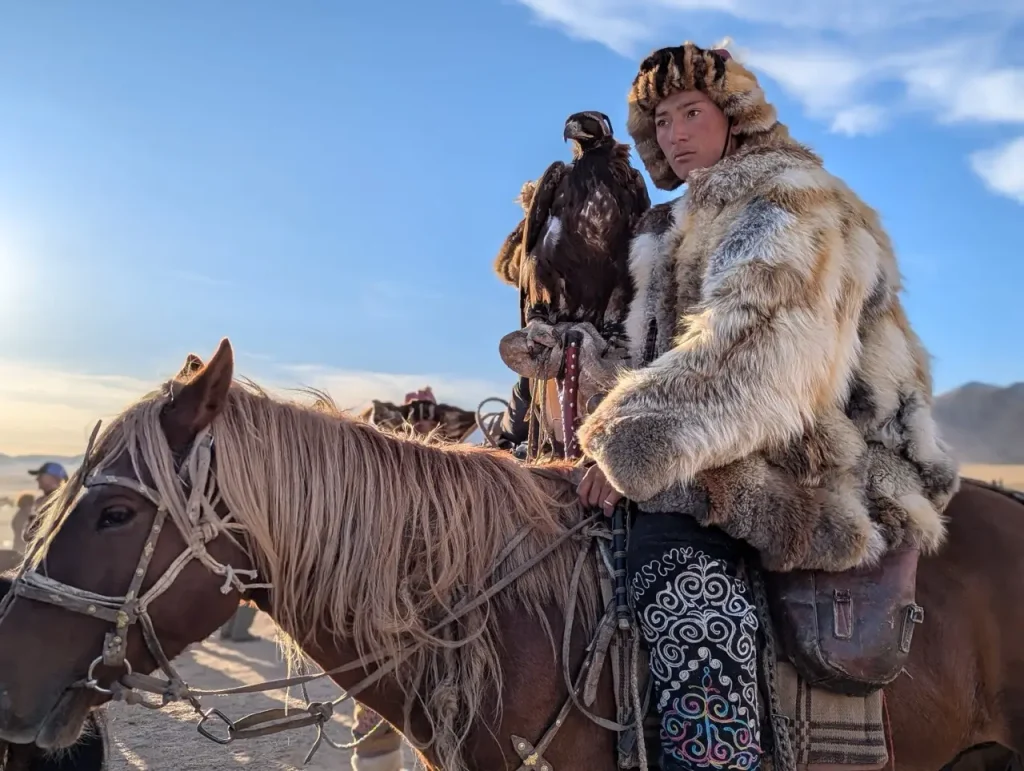
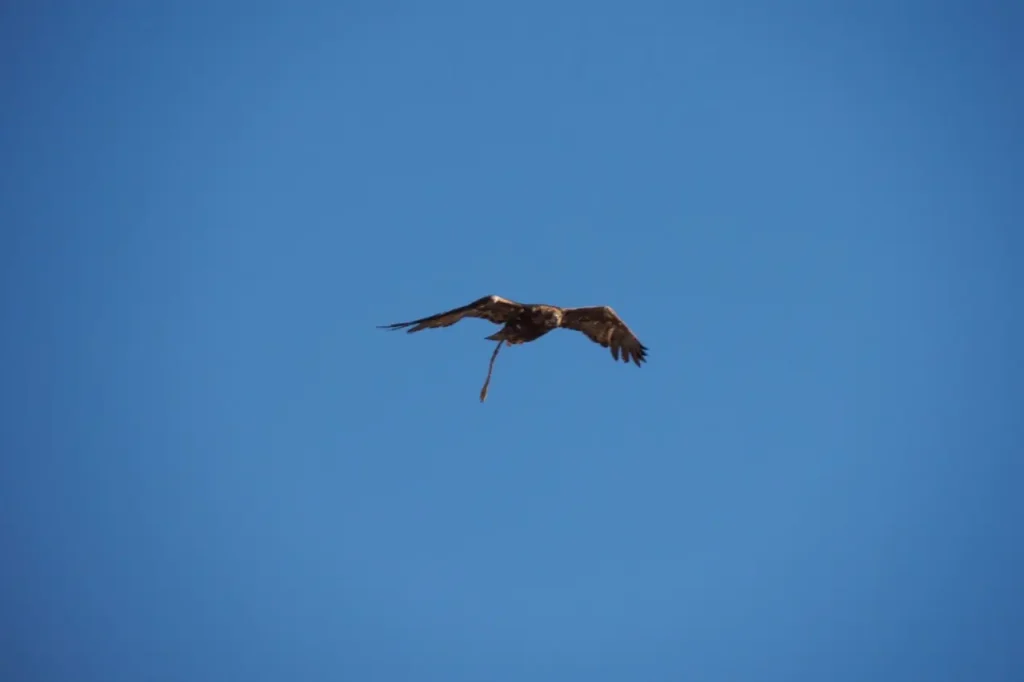
There is a moment at the start of the Mongolia Golden Eagle Festival when the world goes silent. A lone hunter stands atop a crag of sun-scorched granite, his silhouette cutting a jagged line against the “Eternal Blue Sky.” On his arm, four kilograms of feathered lightning, The gaint Golden Eagle waits for the signal. When the leather hood is pulled back, and the bird launches, the sound of six-foot wings beating against the thin mountain air is something you don’t just hear; you feel it in your chest.
This isn’t a performance for tourists. It is the survival of a 6,000-year-old pact between man and raptor. If you are planning Mongolia tours for 2026 or 2027, this is the raw, visceral reality of the Altai.
1. The Ritual: The Heartbeat of the Competition
The festival is a multi-day gauntlet that tests the intelligence of the bird, the nerve of the rider, and the ancient bond between them. In the Altai, an eagle is not a pet; it is a spiritual partner. Here is what actually happens on the festival grounds:
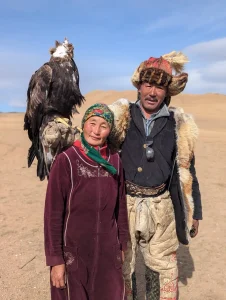
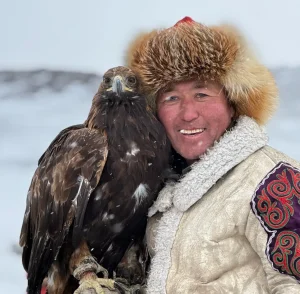
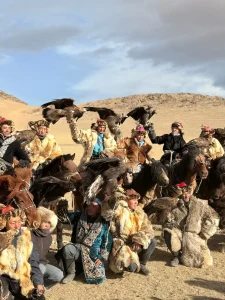
- The Grand Parade: The opening ceremony is a deafening, kaleidoscopic riot of color. Imagine nearly a hundred hunters descending the mountain at full gallop, their horses’ hooves drumming against the frozen earth. They are clad in fox-fur khitans and embroidered silk, their eagles held aloft like living scepters. The dust kicked up by the horses mingles with the smell of woodsmoke and old leather, creating an atmosphere of pure, unfiltered history.
- The Calling (Calling of the Eagle): This is the ultimate test of the bond. The hunter gallops across the arena, dragging a lure (often a fox skin) behind his horse while chanting a specific, haunting cry. The eagle must recognize its master’s voice from the mountain peak—often hundreds of meters above—and dive with pinpoint accuracy through the wind to land on his moving arm. A successful landing brings a roar from the crowd; a failed one brings a somber silence, reminding everyone that these birds are still wild at heart.
- Kükbar (Goat Skin Tug-of-War): This is where the “Logistics of the Steppe” meet raw power. Two riders fight for possession of a 30kg goat skin, wrestling from horseback at high speed. It is a visceral, high-stakes display of the incredible horsemanship that allowed the Mongols to conquer the known world. You will hear the grunt of the men and the heavy breathing of the horses as they lean into each other in a test of sheer strength.
- Kyz Kuar: A traditional “girl-chase” game that balances the intensity of the hunt with humor and skill. Women on horseback playfully whip men who are attempting to outrun them. It is a striking display of the power and status held by nomadic women in Kazakh culture, and the speed at which they ride is often more impressive than the hunters themselves.
2. The 2026/2027 Intel: Where and When
To witness this, you must be in the right place at the right time. The dates are dictated by the cooling of the earth and the readiness of the birds’ winter plumage.
| Year | The Sagsai Experience (Intimate) | The Main Event (Grandeur) |
| Location | Sagsai Soum (Small, family-focused) | Ölgii City (Massive, prestigious) |
| 2026 Dates | September 17–18, 2026 | October 3–4, 2026 |
| 2027 Dates | September 16–17, 2027 | October 2–3, 2027 |
Note: While a Spring Festival occurs near Ulaanbaatar in March, the Altai festivals listed above are the definitive “Eagle Festival tours” experiences.
3. The Experience: Living the Nomadic Life
When you sign up for Eagle Festival tours, the competition is only half the story. The real experience happens in the Gers (yurts) scattered across the valley.
The Hospitality of the Ger
Inside a Kazakh Ger, the world is warm and scented with tea and mutton. You will sit on hand-woven carpets while the Berkutchi tells stories of hunts past. You will be served Beshbarmak (five fingers), a traditional dish of boiled meat and flat noodles eaten by hand. To stay in a Ger during the festival is to understand the Mongolian concept of hospitality: no stranger is ever turned away. You might fall asleep to the sound of the Dombra (a two-stringed lute) being played softly as the fire in the center of the tent crackles.
The Photographer’s Dream: Sagsai vs. Ölgii
- Sagsai (September): The “insider’s” choice. Because it is smaller, the barrier between you and the hunters disappears. The light in mid-September is softer—a “Golden Hour” that lasts all afternoon. You can sit among the families and watch the younger generation practice their skills without the press of thousands of tourists.
- Ölgii (October): The epic of the West. It is louder, dustier, and far more competitive. If you want the “National Geographic” shot of a hundred eagles in the air and the roar of a crowd as a hunter claims his victory, this is your destination.
4. The Philosophy of the Hunt: A Temporary Pact
One of the most intriguing aspects of Mongolia tours is learning about the life cycle of the eagle. The hunters do not breed these birds in captivity. Instead, they catch a female “Balapan” (young eagle) from the wild.
The hunter lives with the bird, feeds it from his own hand, and even sleeps near it to bond their spirits. However, the pact is not for life. After approximately ten years of hunting together, the hunter takes the eagle to a remote mountain peak, offers it a final meal, and releases it back into the wild to find a mate and continue the species. It is a bittersweet ritual that highlights the nomad’s deep respect for nature’s autonomy.
5. The “Need-to-Know” Before You Go
If you are looking at eagle festival tours, forget the glossy brochures for a moment. This is the raw truth of the experience:
- The Altai Bite: The weather here is a living thing. In October, the sun is fierce enough to burn you at noon, yet by 6 PM, the temperature will plummet to $-10^\circ\text{C}$ ($14^\circ\text{F}$). You must pack for both extremes—layers are your only protection against the wind that sweeps off the glaciers of Tavan Bogd.
- The Nomadic Minute: Nothing starts exactly on time. A “10 AM start” might mean 11:30 AM once the last hunter has finished his tea. Patience is the currency of the steppe.
- The Bond: Respect the birds. These eagles are apex predators, capable of taking down a wolf. Observe the distance the hunters keep and never attempt to touch a bird without the master’s explicit permission.
- The Buffer: Flights to the West (Ölgii) are at the mercy of the Altai winds. Always, without exception, build a 24-hour buffer into your return trip to Ulaanbaatar. This “buffer day” is your insurance policy against the shifting moods of the Mongolian sky.
The Mongolia Golden Eagle Festival is more than a contest; it is a defiance of the modern world. In the shadow of the mountains, you aren’t just watching history—you are standing inside it.