The Ultimate Guide to Nomadic Homestays in Mongolia
For those who have spent their lives in cities of glass and concrete, the Mongolian steppe feels like another planet. It is a place where the horizon is an unbroken line and the only fences are the mountains themselves. But the true heart of this landscape isn’t the scenery—it’s the families who move with it.
Staying with a nomadic family is the definitive Mongolian experience. It is a chance to unplug from the digital world and plug into a way of life that has remained largely unchanged since the era of the Great Khans. For travelers seeking a journey of depth rather than just distance, here is everything you need to know about living under the felt of a traditional Ger.
1. Is it Common? The Reality of Nomadic Life
One of the most frequent questions we receive is: “Is nomadic life still a real thing, or is it just for show?”
The answer is a resounding yes. Approximately 30% of Mongolia’s population is still fully or semi-nomadic. This isn’t a “living museum” or a performance for tourists; it is a vital, working economy based on livestock and the seasonal search for pasture.
While you might see a solar panel outside a Ger or a motorbike parked next to a horse, the fundamental rhythms—milking the cows at dawn, moving the camp four times a year, and the fierce independence of the steppe—remain fully intact. In Mongolia, hosting a guest isn’t just common; it is a sacred duty. Because everyone on the steppe has at some point needed shelter from a storm, the culture has evolved to be the most welcoming on Earth.
2. Where Can You Do It? The Three Great Steppes
While you can find nomadic families throughout the country, each region offers a vastly different flavor of life.
The Western Altai (The Land of the Eagle)
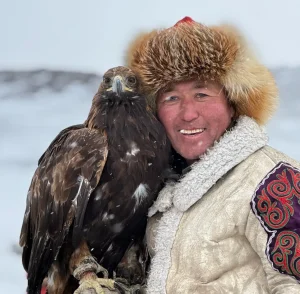
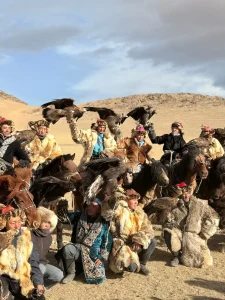
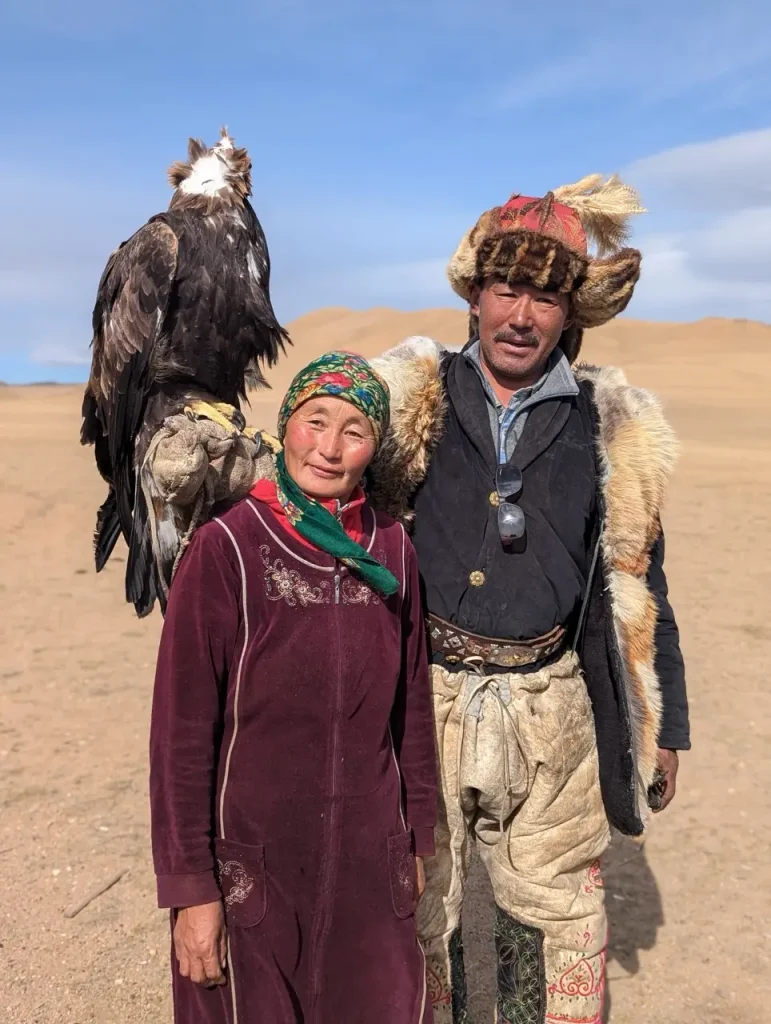
This is the most rugged and culturally distinct region. Here, you stay with Kazakh families who are famous for their golden eagles. The terrain is mountainous, the food is rich, and the cultural identity is a blend of Mongolian grit and Kazakh tradition. This is where you go if you want to see the Mongolia Golden Eagle Festival up close.
The Gobi Desert (The Land of the Camel)
In the south, life is dictated by the search for water. The families here are masters of the Bactrian camel. A stay in the Gobi is a lesson in minimalism. You will experience the “Singing Sands,” the dramatic Flaming Cliffs, and the incredible resilience of families who thrive in one of the harshest environments on the planet.
Central Mongolia (The Land of the Horse)
The Orkhon Valley and the surrounding steppe are the quintessential Mongolian heartland. This is the region of lush green grass, rolling hills, and vast herds of horses and yaks. It is arguably the most “comfortable” entry point for a homestay, offering easier access from the capital, Ulaanbaatar, while still providing total immersion in nomadic life.
3. What to Expect: Life Inside the Felt
When you cross the threshold of a Ger, you are entering a space that is both a home and a cosmological map. Here is the reality of your stay:
The Physical Space
A Ger is a miracle of engineering. It is made of wooden lattices covered in layers of sheep-wool felt. It stays cool in the heat and warm in the sub-zero Altai winds. Inside, there is no “private” room. You will sleep on a daybed or a thick rug on the floor, sharing the communal space with the family.
The Facilities (Or Lack Thereof)
This is where the adventure truly begins.
- The Bathroom: Does not exist. You will use a designated trench or find a quiet spot behind a distant ridge.
- The Shower: Water is hauled by hand from rivers or wells. You will learn the art of the “basin wash,” using a small amount of warm water to stay clean.
- Electricity: Many families have solar panels that power a single lightbulb or a television, but you should bring power banks for your own devices.
The Diet
The nomadic diet is based on the “Five Snouts”—horses, camels, cattle/yaks, sheep, and goats. You will be offered:
- Suutei Tsai: Salty milk tea (the fuel of the steppe).
- Beshbarmak: Boiled meat and noodles, eaten by hand.
- Aruul: Dried curd that is hard as a rock and surprisingly sour.
- Airag: Fermented mare’s milk (an acquired taste, but a cultural necessity).
4. How to Do It: A Step-by-Step Plan
Integration into a nomadic family shouldn’t be left to chance. To ensure the experience is respectful and rewarding for both you and the host, follow this plan.
Step 1: Choose Your Level of Immersion
Decide if you want a “managed” stay or a “deep-dive” stay.
- Managed: You stay in a guest Ger next to the family. You have a bit more privacy, but you are a spectator.
- Deep-Dive: You sleep inside the family’s Ger. You help with the milking, the cooking, and the herding. This is what we recommend for true travelers.
Step 2: Prepare Your Gear
The steppe is unforgiving. Your toolkit should include:
- A High-Quality Sleeping Bag: Rated for $-15^\circ\text{C}$ ($5^\circ\text{F}$), even in autumn.
- Headlamp: Essential for night-time navigation.
- Wet Wipes: Your primary “shower” for the duration of the stay.
- Gifts: Avoid plastic trinkets. Bring useful items like headlamps, high-quality pocket knives, or bags of sugar, flour, and tea.
Step 3: Master the Etiquette
Respect is the currency of the nomad.
- Always move clockwise inside the Ger.
- Never step on the threshold when entering.
- Accept everything with your right hand, even if you only intend to take a small sip.
- Never point your feet at the fire or the family altar.
5. Booking With Us: The Gateway to Authenticity
While you can technically head into the wilderness and hope for the best, the most rewarding stays are built on relationships. This is where we come in.
Why Book With Us?
We don’t just “find” families; we have spent years building trust with specific nomadic communities. When you book your stay through us, you are being introduced as a “friend of a friend,” not just a paying tourist.
What our service includes:
- Curated Families: We work with families who actually want to share their culture, ensuring the interaction is genuine and not transactional.
- Local Translators: We provide skilled guides who don’t just translate words, but translate the culture, helping you understand the “why” behind the rituals you are witnessing.
- Fair Compensation: We ensure that the families are paid directly and fairly, supporting their nomadic livelihood and helping them preserve their traditions.
- Logistics & Safety: We handle the 4×4 transport, the supply runs, and the emergency protocols so you can focus entirely on the experience.
How to Start Your Journey
If you are ready to trade the hotel lobby for the Altai horizon, the process is simple:
- Contact us with your preferred region (Altai, Gobi, or Central).
- Select your dates (Sagsai and Ölgii festival weeks are the most popular, so book at least 6 months in advance).
- Complete a brief profile so we can match you with a family that fits your interests (e.g., if you are interested in horses, eagles, or traditional cooking).
Conclusion: The Prize of the Steppe
When you finally leave your host family and head back toward the lights of the city, you will realize that you are carrying something intangible. You have lived in a world where time is measured by the length of shadows and wealth is measured by the health of a herd.
You might still have dust in your hair and the scent of woodsmoke on your clothes, but you will also have the memory of the silence, the warmth of the sheep-wool felt, and the realization that for a few days, you weren’t just a guest—you were part of the heartbeat of the Altai.
The steppe is calling. Let us help you answer.