Mongolia Currency & Money Tips
Mongolia uses the Mongolian Tögrög (also spelled Tugrik, MNT) as its currency. Understanding how money works on the ground — and, crucially, how to access it outside Ulaanbaatar — will save you significant stress during your trip.
The Mongolian Tögrög
At the time of writing, the exchange rate sits at approximately 3,400–3,500 MNT to 1 USD and around 4,200–4,400 MNT to 1 EUR, though rates fluctuate. Mongolian banknotes come in denominations of 10, 20, 50, 100, 500, 1,000, 5,000, 10,000, and 20,000 tögrög. The 10,000 and 20,000 notes are your workhorses for daily use; smaller denominations are useful for markets and tips.
Mongolia uses the tögrög exclusively for domestic transactions. USD is widely understood in Ulaanbaatar (particularly in tourism-facing businesses) but is not generally accepted as payment. Exchange currency or withdraw local cash on arrival.
ATMs in Ulaanbaatar
ATMs are plentiful in Ulaanbaatar. Khan Bank, Golomt Bank, and Trade and Development Bank (TDB) all have reliable international ATM networks throughout the capital. Visa and Mastercard are widely accepted, and most modern ATMs allow withdrawals in tögrög on foreign cards.
Daily ATM withdrawal limits typically range from 300,000 to 500,000 MNT per transaction (roughly $90–$150 USD), so if you need larger amounts, be prepared to make multiple withdrawals.
Currency Exchange
Licensed exchange bureaux are found throughout Ulaanbaatar, in major hotels, the State Department Store, and at the airport. Rates vary — compare a few before exchanging. USD and EUR are the easiest currencies to exchange; GBP, AUD, and JPY can also be exchanged in the city. Keep receipts if you intend to re-exchange unused tögrög on departure.
Avoid exchanging money with unlicensed street changers. The rates may look attractive but fraud and short-changing are risks.
Outside Ulaanbaatar: Plan for Cash
This is the critical point that many travellers don’t fully appreciate: rural Mongolia is substantially cash-only. In smaller towns like Ölgii, Mörön, or Dalanzadgad, ATMs exist but may be out of service, out of cash, or unable to process foreign cards reliably. In truly remote areas, there are no banking facilities at all.
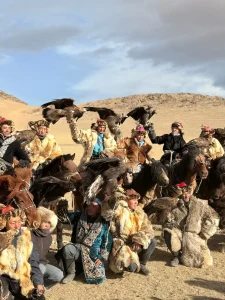
If your tour involves time in western Mongolia — the Altai region for eagle festivals — arrive in Ulaanbaatar with enough cash to cover your personal expenses for the entire trip. Your tour costs will be covered by your booking payment, but personal spending money, tips, souvenirs, and any extras need to be in tögrög before you leave the capital.
A practical rule: withdraw or exchange enough for your trip in Ulaanbaatar, then treat everything rural as cash-only country.
Card Payments in Ulaanbaatar
Better hotels, restaurants, and shops in Ulaanbaatar accept Visa and Mastercard. The State Department Store and modern shopping centres are card-friendly. However, don’t rely on card acceptance — always have a reserve of cash for smaller establishments, street food, and local markets.
Tipping Culture
Tipping is appreciated but not obligatory in Mongolia. For tour guides and drivers — who are the backbone of any successful Mongolia trip — a tip of $10–$20 USD per day for a guide and $5–$10 per day for a driver is a generous and appropriate gesture, paid in local currency or USD. Your operator may provide guidance on tipping etiquette.
Practical Summary
Arrive with cash reserves. Use ATMs in Ulaanbaatar. Don’t rely on cards outside major cities. Budget your personal expenses in advance and carry the full amount. The logistics of money in Mongolia are manageable with a little preparation — and once sorted, you can focus entirely on the extraordinary landscape around you.