Ethics of the Eagle: Is the Golden Eagle Festival Ethical?
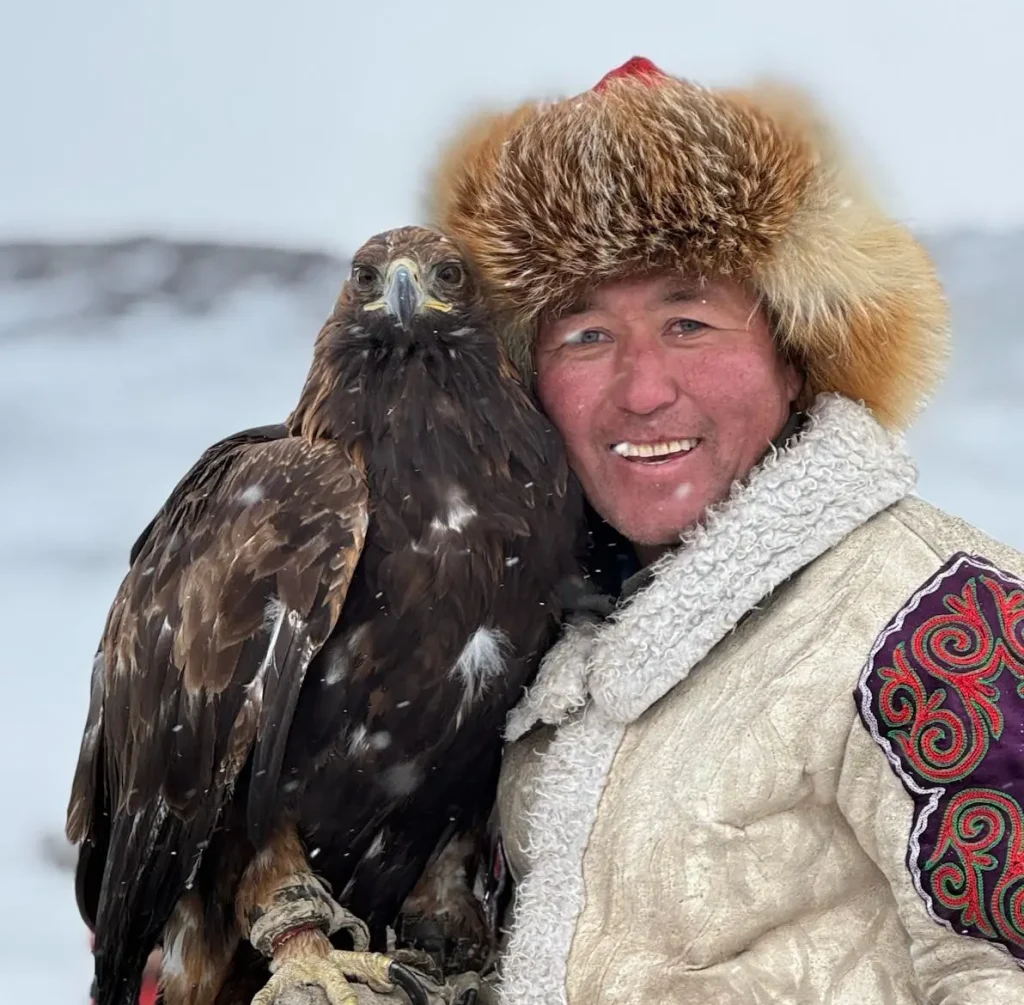
In the age of ethical travel, the sight of a wild apex predator tethered to a human arm inevitably raises questions. For those scrolling through vibrant images of the Mongolia Golden Eagle Festival, the spectacle is undeniable. But beneath the fox-fur hats and the dramatic mountain backdrops lies a complex moral landscape.
As travelers increasingly seek out Mongolia tours that align with conservation values, the question must be asked: Is the Golden Eagle Festival an exploitative circus, or is it the very thing keeping an ancient species—and an ancient culture—alive?
To answer this, we must look past the “Grand Parade” and into the dark, smoky interiors of the Gers, the biology of the raptors, and the bittersweet ritual of the release.
1. The Biological Pact: Capture and Training
The primary ethical concern for many western visitors is the capture of a wild bird. Unlike western falconry, which often uses captive-bred birds, the Kazakh hunters of the Altai exclusively take their eagles from the wild.
The Selection Process
Hunters typically target female “Balapan” (fledglings) or “Khyrana” (one-year-olds). Females are preferred because they are larger, more aggressive, and more capable of taking down the foxes and wolves that are the traditional targets of the hunt.
Ethical Consideration: While removing a predator from the wild sounds inherently damaging, the Berkutchi argue that they are providing a “survival school.” In the harsh Altai winters, a significant percentage of young eagles perish due to starvation or disease. An eagle raised by a hunter is guaranteed food, shelter from the winds, and protection during its most vulnerable years.
The Training Method
The training is based on positive reinforcement—never punishment. The hunter and the bird share an intimate, almost obsessive bond. The eagle lives inside the Ger with the family, becoming accustomed to the sounds of children, dogs, and domestic life. This immersion is designed to reduce the bird’s stress, not to “break” its spirit. The leather hood, often viewed by outsiders as a sensory deprivation tool, is actually a vital safety device that keeps the bird calm in high-stimulus environments like the festival grounds.
2. The Festival vs. The Hunt: Spectacle vs. Survival
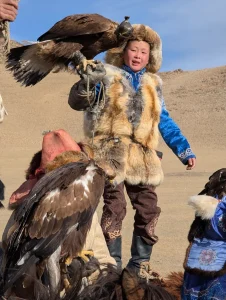
One of the most frequent criticisms of Eagle Festival tours is that the events feel like a “show” rather than a true hunt. During the festival, eagles are tasked with landing on their master’s arm or diving for a dead fox skin (a lure).
The Role of the Lure
To the untrained eye, dragging a fox skin behind a horse looks like a pantomime. However, this is a critical training exercise. In the wild, an eagle has a limited number of “misses” before it loses the energy required to hunt again. The festival competitions simulate the precision required for a real winter kill.
Does Tourism Dilute the Tradition?
There is no denying that the Mongolia Golden Eagle Festival has been influenced by the “tourist gaze.” Prizes are now awarded for the most beautiful traditional dress and the most ornate silver-mounted saddles. However, many cultural anthropologists argue that without the economic incentive provided by Mongolia tours, the tradition would have likely vanished during the Soviet era. The festival has made being a “Berkutchi” prestigious again for the younger generation, ensuring the skill set—and the eagle population’s value—remains high.
3. The “Release” Ritual: The Ethical Centerpiece
If there is one factor that separates Mongolian eagle hunting from almost every other form of animal “performance,” it is the Release.
In the Kazakh tradition, an eagle is not a lifelong servant. After approximately seven to ten years of partnership, the hunter performs a final ritual. He takes the eagle to a remote, sacred mountain peak, far from human habitation. He kills a sheep as a final feast for the bird, thanks it for its years of service, and leaves it to return to the wild forever.
The Why
The hunters believe that seven to ten years is the “prime” of an eagle’s life. By releasing the bird at this age, they are ensuring that a strong, experienced, and healthy female returns to the wild population to find a mate and breed. This prevents the “genetic drain” that would occur if the birds were kept until death.
The Result: This practice has created a unique, self-sustaining loop. The hunters act as temporary guardians, and the “released” eagles contribute back to the wild population, ensuring that the next generation of Berkutchi will have a healthy population of eaglets to choose from. This is a form of conservation that predates modern environmental science by centuries.
4. Addressing Modern Concerns: Tethering and Living Conditions
Despite the beauty of the release ritual, modern animal welfare standards raise points that cannot be ignored by those on Eagle Festival tours.
- Tethering: When not flying, eagles are tethered to perches. Critics argue this limits natural movement. Hunters contend that a free eagle in a camp would likely be attacked by dogs or fly off prematurely before it is ready to survive a winter hunt.
- The “Lure” Quality: At some smaller, less regulated festivals, there have been reports of using live bait (like rabbits) for the entertainment of tourists. This is widely condemned by the official Golden Eagle Festival organizers. Ethical travelers should support only the main festivals in Ölgii and Sagsai, which have strict rules against the use of live prey for competition.
- Stress Levels: The noise and sheer volume of people at the Ölgii festival can be stressful for the birds. This is why the Sagsai Gathering is often recommended for more ethical-minded travelers—it is quieter, more spaced out, and focuses more on the hunters’ daily lives than the “stadium” atmosphere of the capital.
5. The Kazakh Perspective: The Eagle as a Soul
To ask a Kazakh hunter if his eagle is “happy” is to ask a question that doesn’t quite translate. To the Berkutchi, the eagle is a member of the family. They describe the bird not as an asset, but as a “soul” that has chosen to work with them.
When a hunter speaks of his bird, he speaks of her personality—her bravery, her stubbornness, her intelligence. This deep, spiritual respect is the ultimate safeguard against cruelty. A hunter who mistreats his bird is not just an “unethical owner”; he is a man who has shamed his ancestors and ruined his own reputation in the community. In a nomadic society where reputation is everything, this is a powerful deterrent.
6. How to be an Ethical Spectator
If you are planning to join Eagle Festival tours in 2026 or 2027, your presence can either help or hinder the ethical balance of the event.
- Support Local: Choose tour operators that employ local Kazakh guides and stay in local Ger camps. Ensure your money stays in the community that maintains the tradition.
- Observe the “Hood”: Never ask a hunter to remove an eagle’s hood just for a photo. The hood is there for the bird’s comfort and safety.
- Respect the Distance: During the competition, stay behind the designated lines. A distracted eagle can miss its master’s arm, leading to injury for the bird or the rider.
- Ask About the Release: Engage with the hunters. Ask them how many birds they have released in their lifetime. By showing that you value the “Release” as much as the “Hunt,” you encourage the preservation of the most ethical part of the tradition.
The Verdict: A Living Heritage
Is the Mongolia Golden Eagle Festival ethical? If viewed through a strictly urban, 21st-century Western lens of animal rights, any form of captivity is difficult to justify. However, if viewed through the lens of cultural survival and conservation, the festival is a vital success story.
It is a rare example of a traditional practice that actually incentivizes the protection of a wild species. Because the eagles are so valuable to the Kazakh culture, the habitat of the Altai Mountains is protected, and the birds are treated with a level of reverence rarely seen in modern agriculture or entertainment.
In the shadow of the Altai Tavan Bogd, the bond between the hunter and the eagle remains one of the last true symbols of man’s place within the natural world—not as a master, but as a temporary partner in a cycle of survival.